22 hours
You must log in or register to comment.
 2 hours
One of the first things that page says is that it generates less force than a standard marine propeller. That seems like it’d be less efficient and use more fuel to me.
- Theoriginalthon@lemmy.worldEnglish9 minutes
You can’t compare total force output to efficiency like that. You need power in and power out.
_However, the global economic crash caused a decrease in consumer buying confidence. In addition to this, Marine Diesel Oil (MDO) and the related engine technology required to use it became readily and cheaply available. Fuel prices at that point meant that any savings achieved by the rotor were too small for shipping companies to consider the investment due to the lengthy payback period. _
So yeah cheap fossil fuels strike again
- Warl0k3@lemmy.worldEnglish19 hours
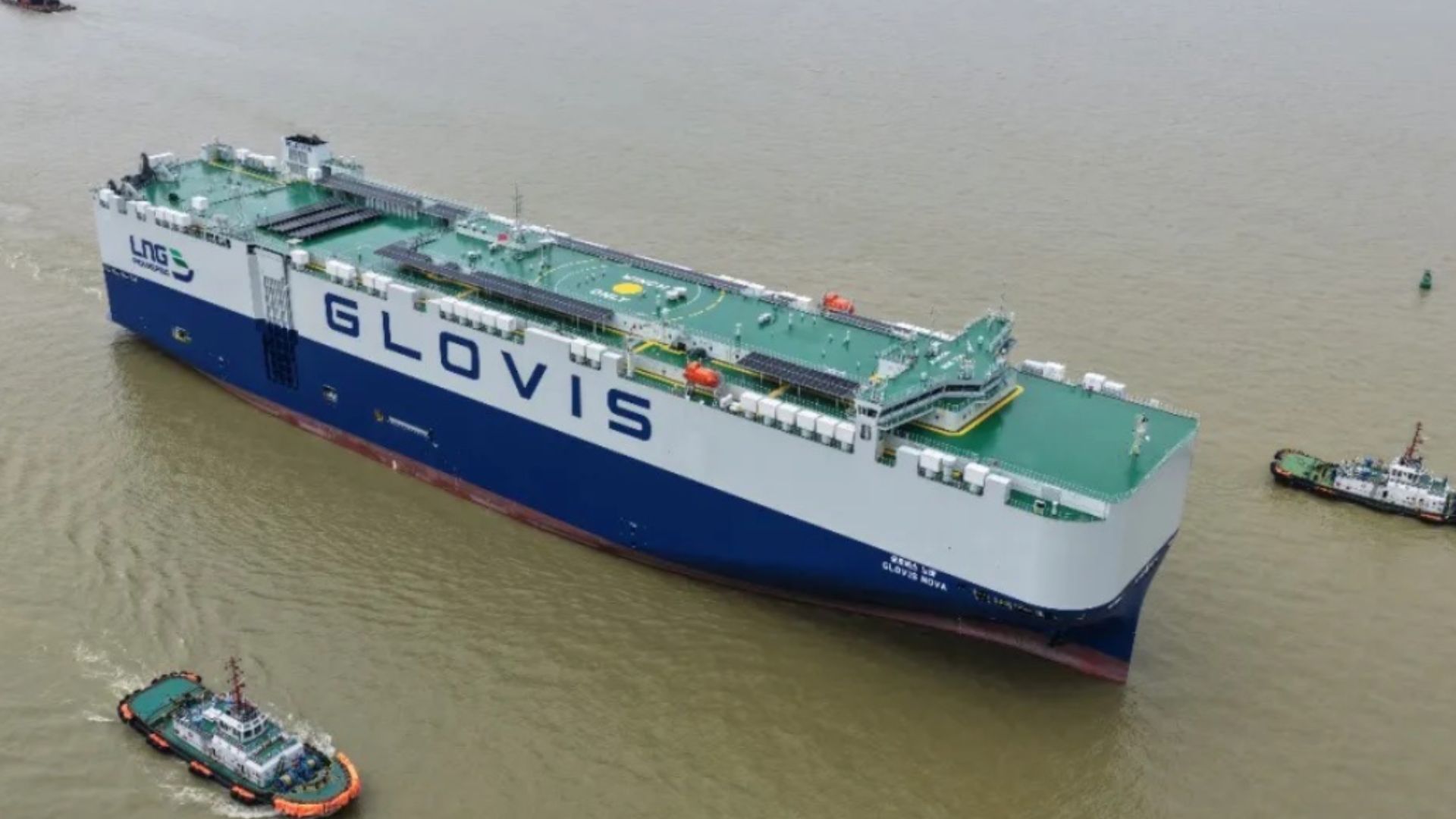
The ship’s solar system can produce up to 200 kilowatts at its peak and generates about 1,000 kilowatt-hours of electricity daily
The carrier also uses a dual-fuel propulsion system that operates on conventional fuel oil and LNG.
I was real excited for electric shipping since one ship like this produces an unbelievable amount of pollution, but this is kinda pitiful in comparison to the power needs of these ships:
The propulsion arrangement on each ship includes one MAN 6S60MC-MK 10.5-GI-EcoEGR main engine with a rated output of 14,950 kW (20,000 hp) driving a propeller, a 2,000kW bow thruster, and three Himsen 8H22CDF 1,500kW generators. The LNG fuel is stored in two type C tanks with a combined capacity of 1,700 cubic metres (370,000 gallons).
1000kwh isn’t nothing
and I suppose it might meet the ship’s power needs while in port(edit: nvm average shore power consumption for a panamax is 600kw) but this feels like a whole lot of greenwashing given they don’t mention the power requirements in the article.- bountygiver [any]@lemmy.mlEnglish14 hours
hmm quite disappointing, guess to run something power hungry but has limited space like a ship nuclear might be the way if you want it fast, if you don’t need it fast you could go wind power (sails are so back)
- pHr34kY@lemmy.worldEnglish14 hours
Your average electric Porsche consumes more than 200kW.
It’s basically rounding error when you lug 10,000 of them.
- GreenKnight23@lemmy.worldEnglish19 hours
honestly surprised they don’t have something that utilizes the forces of the ocean to generate a charge.
- ohulancutash@feddit.ukEnglish19 hours
Which would increase drag and make it a worthless exercise. It would also mean loss of power in stormy seas, and who wants manoeuvrability in those sort of conditions anyway?
- GreenKnight23@lemmy.worldEnglish18 hours
that’s quitter talk. if we can send trash into orbit we can certainly find a way to leverage oceanic motion.
- Earthwormjim91@lemmy.worldEnglish8 hours
We already do with tidal generators.
And theres ways to follow currents for extra help, but you’re limited to that and where the current moves.
Anything else and you’d have to violate the laws of physics.
It’s like putting a wind turbine on an electric car. The increased drag would cost more electricity than the turbine could produce.
- Warl0k3@lemmy.worldEnglish15 hours
Tidal generators are very much a technology (one, admittedly, in it’s infancy). The forces the ocean provides are generally too extreme to be casually harnessed, and even something as seemingly benign as waves redounding on the beach contain energy on the scale of nuclear weapons, and it’s contained in an extremely corrosive medium (salt water). And that’s not even the deep ocean movements, which are unfathomably (sorry) more powerful even then, and that’s before we get to the fact that the engine driving the tides is the entire damn moon.
Something like a tidal turbine would be completely unworkable on a ship; by their nature they produce energy from the difference of forces - which is to say, they would only generate power as long as the boat is moving counter to the current being harnessed. Even in an ideal world where we’re sovereign citizens to the laws of thermodynamics and have cast off the shackles of entropy, your ship would still have to output the same amount of energy as your turbine is harvesting just to stay in one spot.
There’s another common idea which is to use some kind of “water sail” that harnesses the currents and drags the ships along. The first problem with this is that, unless you’re about to have a very bad day, the ocean is creepily slow. Waves travel through the water, but don’t really displace the water molecules themselves, so there’s very little for an underwater sail to harness (side note: but do make use of underwater sails, but in the exact opposite way most people expect - sea anchors are basically enormous submerged sails, used to keep a ship relatively stationary when it’s too deep to use a traditional anchor). And were we to delve deeper for some of the deep thermal currents, it can take hundreds of years (or more) for water to make a complete cycle, which would be a very slow trip indeed.
Yet another proposal I’ve seen is to have some sort of large sliding body, a bit like those flashlights with a rod in them that you charge by shaking up and down, only much larger. The idea is that as the pitch of the ship changes as it ascends and descends waves, some very large weight (or multiple smaller weights or etc.) slides back and forth through long sets of coils, generating tremendous if quite periodic amounts of energy which is then stored in batteries or etc. This idea has many flaws, but I’ll briefly touch on three:
- The free surface effect, a mechanism through which things moving on a boat cause the spontaneous generation of so many partial differential equations that your ship decides it’ll be easier just to sink itself
- The huge amount of valuable cargo space that has to be dedicated to the generating system
- The question of what to do when you’re stuck on calm seas.
The best approach would be to capture the quicker currents that are close to the surface, which are are often wind driven. There’s actually been huge advancements to harvest wind currents directly, usually using large sheets of cloth (or some other medium with high tensile strength) attached to long towers on the surface of the ship with these things called sails.
… Okay but joking aside, there actually have been really cool advances in using sails on cargo ships, that are extremely promising. More work needs to be done before we see them on a panamax, but there’s already been some fairly eager adoption of rotor sails for smaller cargo ships! It’s super cool tech that I hope can be combined with electrification to massively reduce (or if I were an optimist, eliminate entirely) the impact of shipping. Time will of course tell, but there is some cool progress being made.
- yaroto98@lemmy.worldEnglish20 hours
That looks a little gimmicky to me. I’d expect more panels on that ship if they were going to have a meaningful impact.
- Ilovethebomb@sh.itjust.worksEnglish19 hours
I saw a story about a similar car carrier with solar panels, basically they’re used to offset the hotel load of the ship, and have nothing to do with the propulsion.
Which is still a significant improvement considering how much time a vessel like this spends at port loading and unloading.